Overview
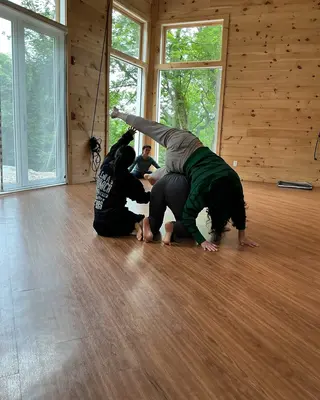
Contact Improvisation began here. Steve Paxton first developed the form in January 1972 during a residency at Oberlin College, then presented it publicly for the first time that June at the John Weber Gallery in New York City, inviting around seventeen dancers and colleagues to join him, including Nancy Stark Smith, Nita Little, Daniel Lepkoff, and Curt Siddall. By 1974 several of them had regrouped in the San Francisco Bay Area, teaching there and touring together the following year as ReUnion, the first formal Contact Improvisation company. Stark Smith took the work in a second direction too: in 1975 she founded Contact Quarterly in Northampton, Massachusetts, co-editing it with fellow pioneer Lisa Nelson for the next 45 years and building it into the field's central journal and archive.
Northampton and the Western Massachusetts and Vermont hills around it remain one of the country's deepest roots. Earthdance, a retreat community in nearby Plainfield founded in 1986, is considered the oldest intentional community built around Contact Improvisation practice, still hosting workshops, jams, and trainings today.
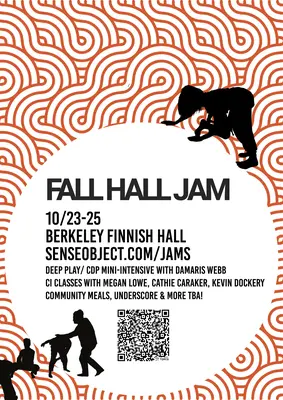
The Bay Area has grown into the country's largest concentration of teachers and organizers. In Oakland, Rene Alvarez has run InterKinected since 2000, organizing the California Contact Improvisation Teachers Exchange and weekly Berkeley classes. San Francisco's own teaching community includes Scott Wells, practicing and choreographing there since 1981.
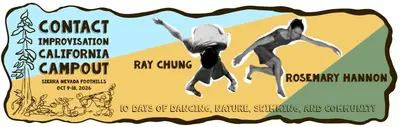
Further north and inland, the practice has its own long threads too. Karen Nelson, a Contact Improvisation pioneer since 1977, co-founded Breitenbush Jam at Breitenbush Hot Springs in the Oregon woods, where Ray Chung would later meet Steve Paxton himself in the 1980s; held every March, it's the longest-running Contact Improvisation jam in the world. In Seattle, Nita Little still teaches internationally as one of the only original 1972 dancers still actively teaching the form. Portland and Bellingham each have their own smaller, active communities.
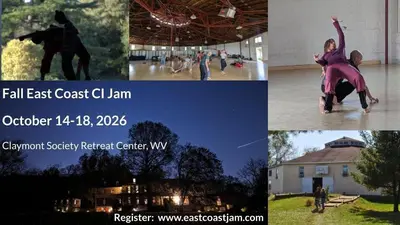
Beyond these hubs, the country is too large and federal for any single summary to cover completely: dozens of other cities, from Boston to Los Angeles, Chicago to Denver, run their own regular practice, and regional gatherings like the East Coast Jam in West Virginia and GLACIER in the Great Lakes region anchor much of the rest. There has never been a single national organization tying it all together, only this loose, city-by-city network of scenes.
Last updated August 2026